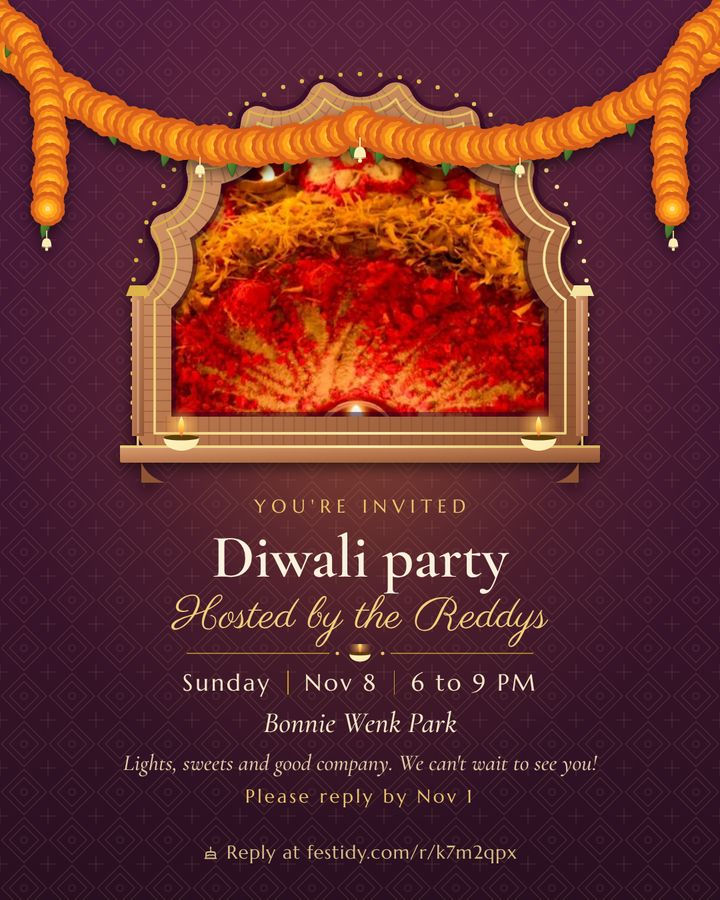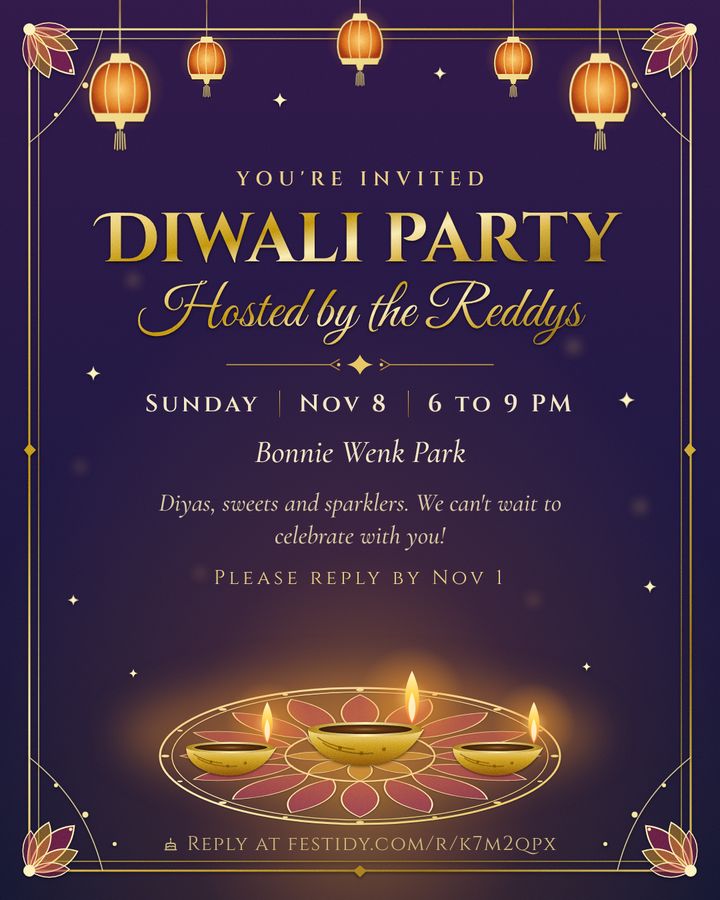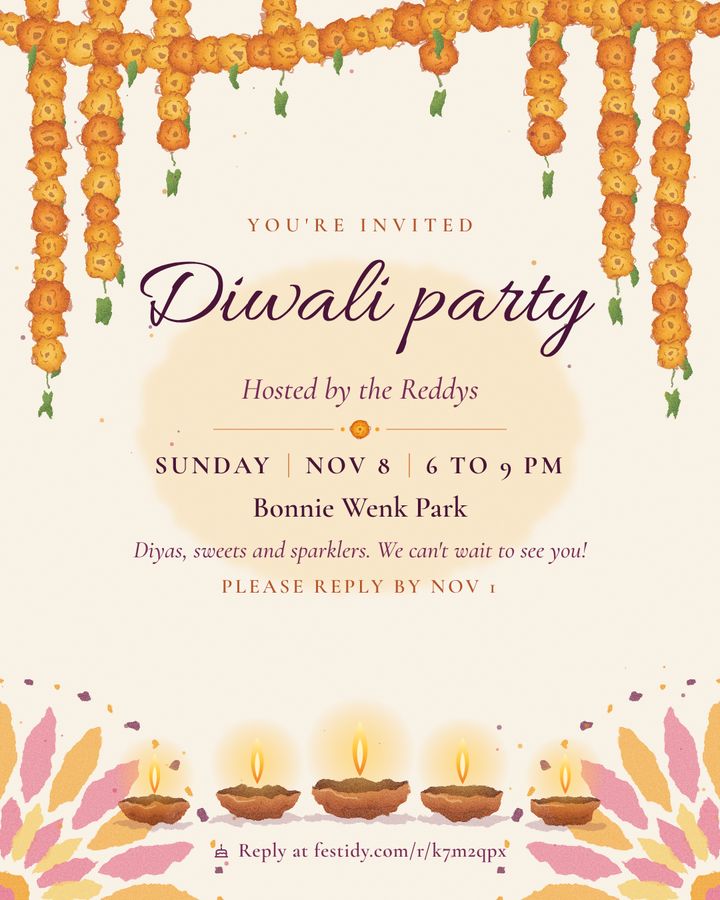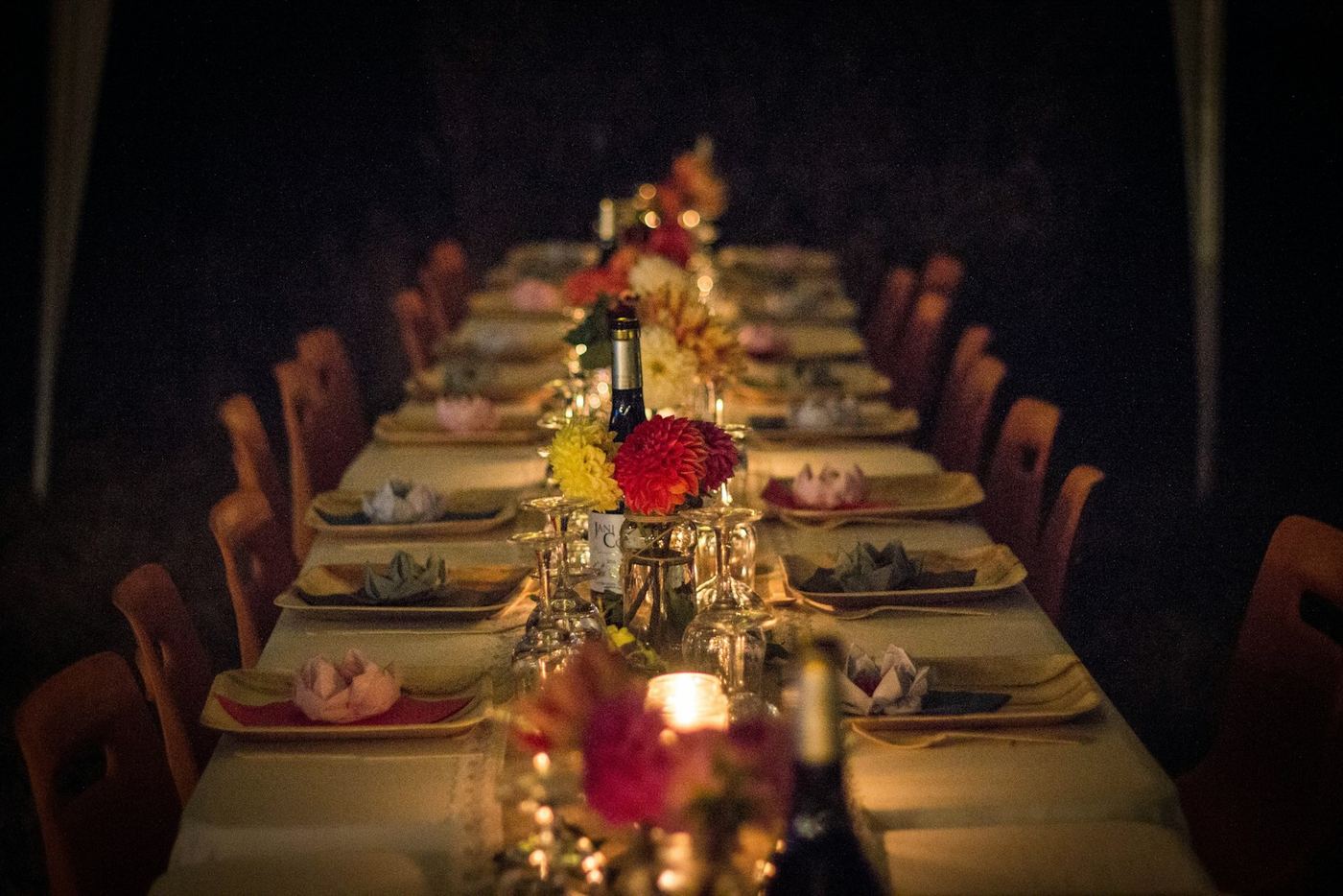
Build your Diwali party around one moment: everyone lighting the diyas together as it gets dark. Add a rangoli at the door, a table of sweets and savory food, and a game of tambola that pulls in every age.
The name comes from Deepavali, "a row of lights." The main night falls on the new moon of the month of Kartika, usually mid-October to mid-November (Princeton University). In 2026 the main day is Sunday, November 8 (Old Farmer's Almanac). Hindus, Jains, Sikhs and Newar Buddhists all celebrate it, for different reasons. The festival runs five days, with stories that differ between north and south India (American University). Every family does it a little differently, so if you are hosting friends who celebrate, ask what matters most to them.
Your Diwali plan for 24 guests
The sample party: 24 guests (about 16 grown-ups and 8 kids), 3 hours, an evening on the weekend nearest the main day.
- Choose a weekend evening and a start time near sunset. Check your local sunset time; once clocks fall back in early November, it comes early. Starting about 30 minutes before gives you daylight to arrive and darkness for the lights. Invite 3 to 4 weeks ahead and ask about allergies on the RSVP; many sweets are made with cashews, pistachios, milk and ghee.
- Decide real flame or LED, room by room. Real clay diyas on the porch and windowsills, where grown-ups can watch them. LED diyas or battery tea lights anywhere kids can reach. Buy about 30 diyas in all, two thirds of them LED if you have small children coming.
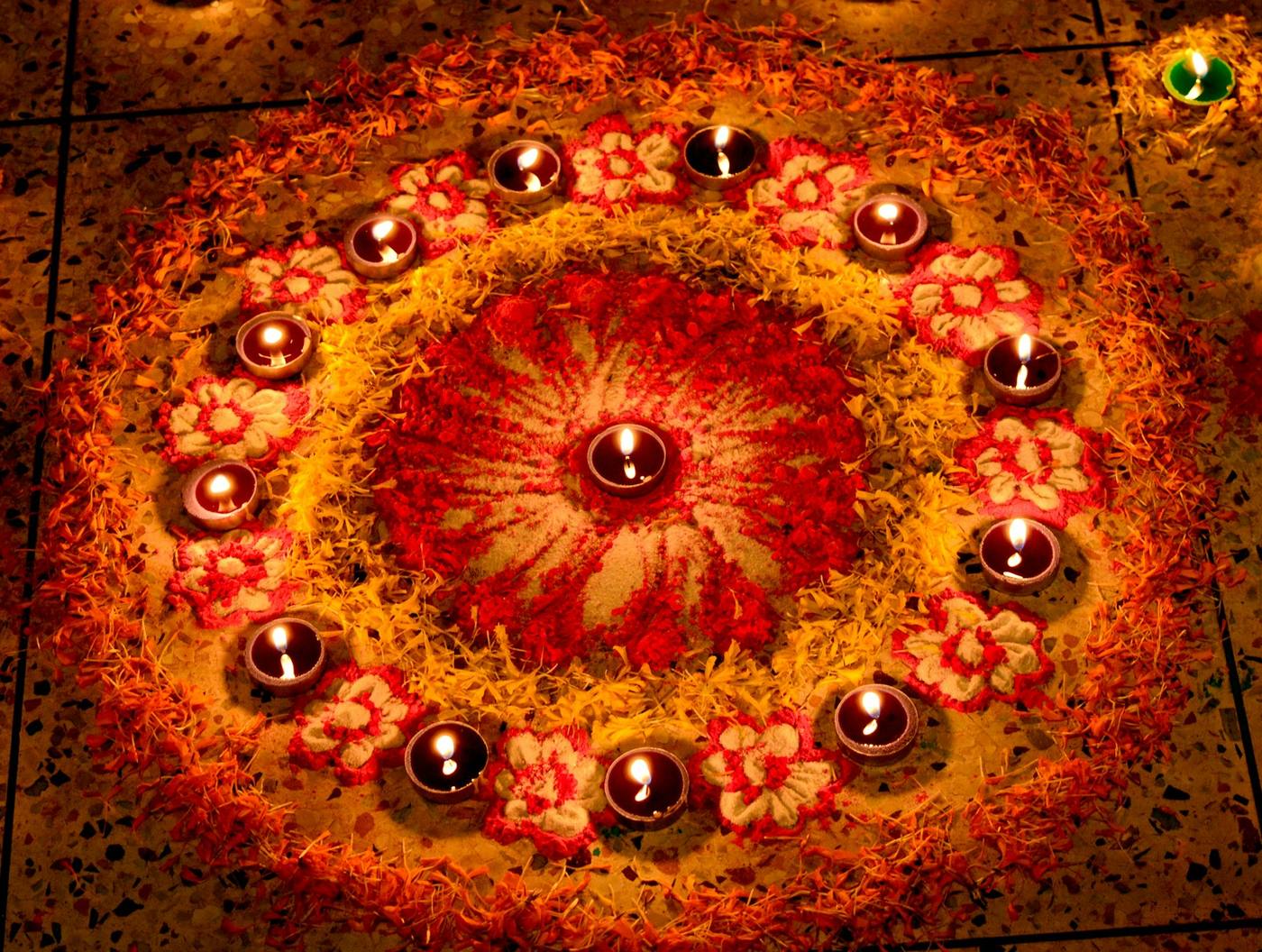
- Draw the rangoli the morning of. Rangoli patterns are made on the floor with colored powders or sand (De Anza College Library). Mark a 3-foot circle with chalk and fill it with powder, rice or marigold petals. Leave a small gap for guests to add petals as they arrive.
- Order the sweets 4 to 5 days ahead. An Indian sweet shop sells mithai by the pound. Plan 2 to 3 pieces per guest, so about 60 to 70 pieces for 24.
- Make the main dish the day before. Chole tastes better on day two. Fry or bake samosas the afternoon of, or reheat bought ones at 375°F for about 15 minutes.
- Print tambola tickets and number cards. One ticket per player and numbers 1 to 90 in a bowl. The games section below has the rest.
- Set the safety kit by the door. A bucket of water, a lighter kept up high, and a tray for lit diyas. This takes two minutes and saves the evening.
The budget at three levels
Festidy plans a house or holiday party at $10, $20 and $40 per guest. For 24 guests:
| Level | Per guest | 24 guests |
|---|---|---|
| Simple Home food, homemade games | $10 | $240 |
| Standard Bakery cake and one hired activity | $20 | $480 |
| Splurge Entertainer, rentals, and custom decor | $40 | $960 |
| Level | For this party, the money goes to |
|---|---|
| Simple, about $240 | Home-cooked chole, rice and puri, store-bought samosas, a mixed box of mithai, 10 plain clay diyas plus 20 LED ones, marigold petals for the rangoli |
| Standard, about $480 | A catered tray or two from an Indian restaurant, a larger sweets order with kaju katli, fresh marigold garlands, jewel-tone cushions and string lights, tambola prizes |
| Splurge, about $960 | Catering from an Indian restaurant for everyone, a chaat station you set up, fresh marigold garlands, and one hired extra: a mehndi artist or a photographer for the lighting moment (each about $150 to $300, so pick one) |
Light it well: the decor that matters
Diyas in rows. Line the walk, the steps and the front windows. Rows read better than scattered lights, and Diwali is literally named for them.
The rangoli at the entrance. Put it just off the walking path, not on it. A rug of rangoli in the doorway gets tracked through the house by the third guest.
Marigold garlands over the door. Fresh ones from an Indian grocery or a florist look and smell best. Silk ones last for years if you host every fall.
Skip confetti, glitter and anything that sheds near open flame. Skip heavy table centerpieces too, since you need the space for platters.
Diyas, candles and sparklers: safety that's easy to follow
Keep every candle and diya at least 12 inches from anything that burns. Set them in stable holders where they can't be knocked over, and blow them out when you leave the room (U.S. Fire Administration). In practice:
- Set clay diyas on a metal tray or a stone step, never straight on a tablecloth or wooden rail.
- Keep them away from curtains, paper lanterns and the coat pile.
- Loose clothing catches fast. Remind guests in a dupatta or sari to keep the ends clear when they lean over to light one.
- Give one grown-up the job of putting out every flame before the last guest leaves.
- Use LED diyas for kids. They can carry and arrange them as much as they like.
Fireworks need extra care. Check that they are legal where you live and keep a bucket of water or a hose ready. Never let young children hold or light them, sparklers included; sparklers burn at about 2,000°F (CPSC). Some cities don't allow home fireworks at all, and a community celebration is a good alternative.
The menu: sweets first, savory to balance
Making sweets, wearing new clothes and sharing gifts are all part of the festival for many families (American University). Pair the sweets with enough savory food that people stay for dinner.
| What | How many | Why |
|---|---|---|
| lb of food | 24 | About 1 lb a guest for a meal |
| Plates | 48 | 60 cups and 72 napkins too |
| Drinks | 96 | Soda, sparkling water, beer or wine: 2 a guest the first hour, then 1 |
| Waters (8 oz) | 36 | 4 oz a guest an hour; or about 2.5 gallons in a dispenser |
| lb of ice | 48 | 2 lb a guest; double it on a hot day |
| Seats | 15 | About 60% of guests at once |
| Dessert servings | 24 | Cake or a dessert table: a quarter sheet |
- Samosas: 2 per guest, about 48, with mint and tamarind chutney.
- Chole: about 1 cup per grown-up and half a cup per kid. That's a large pot made with 4 pounds of dried chickpeas or 10 to 12 cans.
- Puri or rice: 3 puri per adult, or about 6 cups of uncooked rice for the group.
- Drinks: a big pot of masala chai and a pitcher of mango lassi. One gallon of lassi serves about 16 small cups.
Dessert: skip the cake for a mithai tray of ladoo, barfi and kaju katli. If you want a cake, a grocery bakery can do a plain vanilla or pistachio sheet. Stir cardamom into the frosting yourself and top it with dried rose petals. Label anything with nuts, since kaju katli is made from cashews.
Diwali games and activities, from diyas to tambola
Every family plays something different at Diwali, so ask guests what they grew up with and let them lead a round. Keep the craft before the lighting, and the sitting-down games after dinner. Adults and teens play everything below, and kids have their own corner.
Tambola
Ages 8 and up · 30 minutes · everyone
Also called housie. Each player gets a ticket of numbers, and the caller draws from 1 to 90 and reads each one out. Prizes go to the first five numbers marked, each line, and a full house. Draw briskly and stop at the full house.
- You need: 24 printed tickets (free), number cards 1 to 90 in a bowl, 24 pens, 5 small prizes (about $1 to $3 each)
Antakshari
Ages 12 and up · 20 minutes · 2 teams
Teams take turns singing a few lines of a song. Each new song must start with the last letter or sound of the one before. A team that's stuck for 10 seconds loses the round.
- You need: nothing
Team rangoli
Ages 6 and up · 20 minutes · teams of 3 or 4
Rangoli patterns are made with colored powders, rice or flowers (De Anza College Library). Give each team a poster board with a chalk circle and bowls of colored rice and petals, and let them fill a pattern together. There's no winner; line the boards up by the door for photos.
- You need: 6 poster boards (about $1 each), chalk, 4 pounds of rice dyed with food coloring the day before (about $8), a bag of marigold petals (about $5)
Kids' corner: Diwali picture bingo
Ages 4 to 8 · 15 minutes · all the kids
For kids too young to keep up with tambola. Print the Diwali bingo cards and call pictures like diya, rangoli, marigold and sweets. Everyone who gets a row picks a sticker.
- You need: bingo cards from the free printables (free), crayons, a sheet of stickers per kid (about $1)
Activity station: diya painting
Cover a card table, about 3 by 4 feet, with newspaper and set out plain clay diyas, acrylic paints and brushes. Kids paint one each, leave it on a tray to dry through dinner, and take it home with an LED tea light inside. Teens and grown-ups can paint one too.
- You need: 12 plain clay diyas (about $15 to $20), a set of acrylic paints (about $8), 10 brushes (about $5), 12 LED tea lights (about $8), newspaper
Prizes: small and equal: a sticker sheet for every kid, and tambola prizes like a box of sweets or a small candle, about $1 to $3 each. Real flame stays with grown-ups, and sparklers follow the safety rules above.
Games shopping list: tambola tickets, pens, small prizes, poster boards, chalk, rice and food coloring, marigold petals, crayons, stickers, clay diyas, acrylic paints, brushes and LED tea lights.
The party, hour by hour
| Time | What happens |
|---|---|
| 0:00 | Guests arrive, add petals to the rangoli, chai and samosas |
| 0:20 | Diya painting station opens for kids; team rangoli (20 minutes) for everyone else |
| 0:45 | Everyone lights the diyas together, then photos |
| 1:00 | Dinner |
| 1:45 | Tambola (30 minutes), prizes for each line and a full house |
| 2:20 | Antakshari (20 minutes) for teens and grown-ups; Diwali picture bingo for kids |
| 2:40 | Sweets and chai; sparklers outside if allowed and supervised |
| 3:00 | Diyas out, goodbyes |
If it rains, keep the lights on the inside sills and swap sparklers for a second round of tambola.
Favors guests will use
- A small box of four mithai pieces, about $3 to $5.
- A non-candy favor: the clay diya each kid painted, sent home with an LED tea light inside.
Common Diwali party mistakes
- Only sweets on the table. Guests arrive hungry. Serve samosas within the first 20 minutes.
- Real flames at kid height. Put clay diyas up high or outside; keep LED ones low.
- Tambola that runs an hour. Draw numbers briskly and stop at the full house.
- Forgetting the date clash. Families who celebrate may have a temple visit or relatives on the main night. A nearby weekend often works better.
Ways to change it up
- A kids' Diwali afternoon: 2 hours, diya painting, a rangoli made with colored rice, LED lights only, and a sweets tray.
- A sweets swap: each family brings one kind of mithai or a family recipe, and everyone leaves with a mixed box.
- A November double: pair a Diwali evening with a fall dinner for friends; see how to host a Friendsgiving.
For more decor and food ideas, see the Diwali party theme and its free printables, including a Diwali bingo card. When you are ready, the Diwali party plan puts every task on a date.
Diwali party questions
What should guests wear to a Diwali party?
Festive or new clothes are traditional for many families (Princeton University). Tell guests on the invitation that bright colors or Indian wear are welcome but never required.
Is it okay to host a Diwali party if my family doesn't celebrate it?
Yes, as a gathering of friends. Invite people who celebrate, follow their lead on customs, and keep the focus on lights, food and company.
How many sweets do I need?
About 2 to 3 pieces per guest if there is a full meal, and 4 or more if sweets are the main event.
What games are played at a Diwali party?
It varies by family. Tambola and antakshari are easy picks for mixed ages, a team rangoli and diya painting give everyone something to make, and picture bingo works for kids under 8.