Ask about allergies on the invitation, then call the parent of every child who has one about a week before the party. Build the menu around what they tell you, label every dish, keep the safe food apart, and know where the child's emergency plan and medicine are before guests arrive.
You don't need to become an allergy expert to do this well. The child's parent knows their plan best. Your job is to ask early, follow their lead and make their child's afternoon feel normal. Festidy's free party planner asks about allergies on every RSVP and keeps them in one list.
Step 1: Ask on the invitation
Put one plain line on the invitation: "Any food allergies we should plan around? Let us know when you reply." Asking up front means you hear about allergies while you can still change the menu, not when a parent spots the peanut butter cookies.
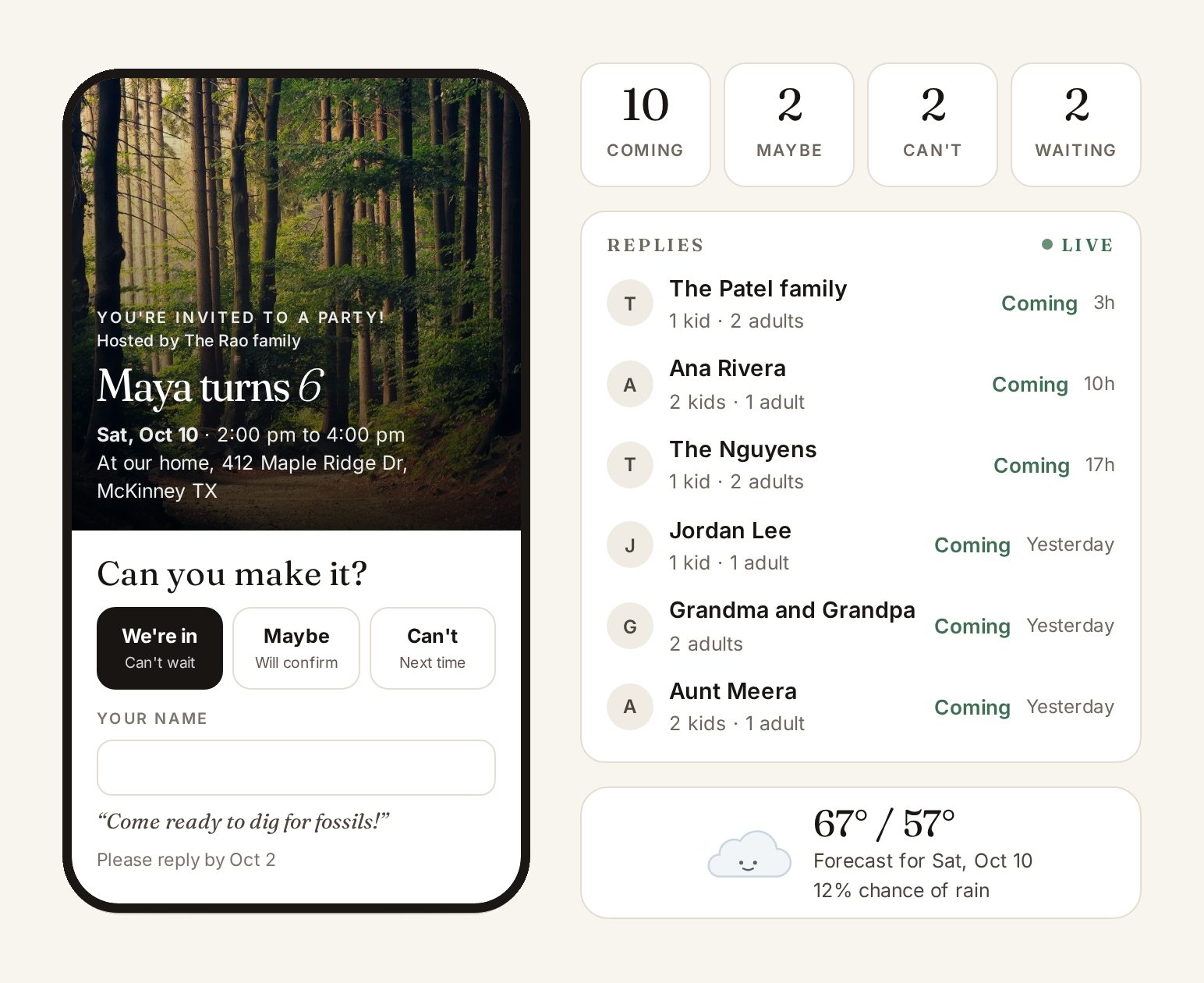
A Festidy invitation has this built in. Guests reply through the RSVP link without making an account, and they can note allergies right there, so the answers land in one list with the headcount. If you send paper or text invitations, add the line yourself. The invitation and RSVP etiquette guide has wording for the rest of the card.
Ask for replies a week before the party. That leaves time for a phone call and one extra shopping trip.
Step 2: Call the parent, and ask these questions
A two-minute call beats a dozen texts. Keep a note open while you talk.
- Which foods, exactly? "Nuts" can mean peanuts, tree nuts or both. Write down each one.
- How careful do you need me to be? Some families avoid "may contain" products, some don't. Follow their rule, not a guess.
- Would you like to send their food? Many parents prefer to bring a safe plate and treat. Say yes and make room for it.
- Will you stay? Offer it warmly. A parent who stays can watch snack time and carries the medicine with them.
- If you drop off, where is the emergency plan and medicine, and who should hold it? Agree on one adult who keeps it within reach for the whole party.
- Anything outside food? Ask about latex balloons, craft supplies and pets.
If something on the menu worries them, change it. A different snack costs a few dollars. Talking a parent into "it should be fine" is never worth it.
The nine major allergens, and where they show up at parties
US food labels must name nine major allergens: milk, eggs, fish, crustacean shellfish, tree nuts, peanuts, wheat, soybeans and sesame, which was added in 2023 (FDA). Here is where they tend to hide on a kids' party table.
| Allergen | Common party foods that contain it |
|---|---|
| Milk | Pizza, cheese, cake, frosting, ice cream, chocolate, many crackers |
| Eggs | Cake, cupcakes, cookies, some frostings, pasta salad dressings |
| Wheat | Pizza crust, sandwich bread, pretzels, crackers, cake, cookies |
| Peanuts | Peanut butter sandwiches, trail mix, candy bars, some cookies |
| Tree nuts | Almond flour baking, pesto, some granola bars and chocolates |
| Soy | Many packaged snacks, baked goods and chocolate |
| Sesame | Sesame buns, bagels, hummus, some crackers and breadsticks |
| Fish and shellfish | Rare at kids' parties, but check sushi platters and some dips |
The table is a starting point, not a safety list. Recipes change, so read the label on every package, every time, even on a snack the child has eaten before (Children's Wisconsin, KidsHealth). The same page notes that "may contain" warnings are voluntary, so a missing warning doesn't promise anything. When in doubt, ask the parent.
A menu that works for more kids
You don't have to rebuild the whole party. Start with Festidy's usual amounts (2 slices of pizza per kid, 3 per adult, 1 juice box per kid an hour plus water), which the food guide spells out, then adjust around the allergies you heard about.
- Lean on whole foods. Fruit and veggie trays and plain chips are easier to check than mixed dishes. Skip whole grapes, popcorn and nuts for kids under 4, since they are choking risks (AAP, HealthyChildren.org).
- Buy packaged where you can. A label you can hand to a parent beats "I think it's fine" on a homemade dip.
- Make one swap, not five. If one child avoids peanuts, drop the peanut items for everyone. It is simpler than guarding one bowl for two hours.
- Keep the packaging until the last guest leaves, so any parent can check.
Tip: Give each allergy-friendly dish its own small tent card listing what's in it ("Contains: wheat, milk"). Use the same words the label uses.
Cake and the candle moment
Cake is where kids most want to match. Pick one of these with the parent.
- The parent sends a cupcake. Put it on the same plate style as everyone else's and light a candle in it too.
- Make the whole cake fit. If the allergy is one food, a bakery or a tested recipe without it may work for everyone. Ask a bakery whether it uses shared equipment, and share that answer with the parent.
- Cupcakes instead of a sheet cake. Order a few from a separate safe batch, and plate those first.
Cake comes out at about 1:20 in a 2-hour party. Serve the allergy-friendly pieces before cutting anything else, so no knife crosses over.
Cross-contact, the part that's easy to miss
Cross-contact is when one food touches another and their proteins mix. A trace you can't see can still cause a reaction, and cooking does not remove it (FARE). These habits cover most of it.
- Prep safe food first, on a clean counter, before anything else comes out.
- Wash, don't wipe. Soap and water removes food proteins. A quick wipe of a knife or a squirt of hand sanitizer does not (FARE).
- Give safe food its own serving spoons, and use separate dish cloths and utensils for safe and other foods (Academy of Nutrition and Dietetics).
- Cover it and set it apart, at one end of the table or on a separate tray.
- Wash hands before snacks. Send everyone to the sink at 1:00, right before food. It doubles as a calm-down break after the main game.
- Watch the buffet. Small hands move chips from bowl to bowl. A grown-up who serves the plates keeps things tidy.
Know the emergency plan before the doorbell rings
A child with a serious food allergy may have a written emergency plan from their doctor, such as the FARE emergency care plan. A plan like that lists the child's allergens, the signs to watch for and what to do. Ask the parent for a copy, and read it before guests arrive.
Before the party, check three things with the parent:
- Where the plan and the child's medicine will be. With a parent who stays, it stays with them.
- Which adult is the point person if the parent leaves. Tell your helpers who that is.
- The parent's phone number, saved in your phone.
If a child seems to be having a reaction, follow the child's emergency plan and call 911. Don't guess, and don't wait to see if it passes. If you aren't comfortable being the point person, say so, and ask the parent to stay. That is a normal, responsible request.
Favors, crafts and decor without food
A food-free goodie bag takes the guesswork out entirely. Small toys, books, bubbles and glow sticks all work (Academy of Nutrition and Dietetics). Plan one favor per child at about $2 to $5 each, and the goodie bag calculator sizes the rest.
Check the non-food extras too:
- Craft supplies. Art supplies don't follow food labeling rules and can contain allergens (Children's Wisconsin, KidsHealth). Check play dough labels, and ask before any craft made with food, like pasta necklaces.
- Balloons. Blowing up rubber balloons can trigger a reaction in people with a latex allergy (ACAAI). Foil balloons are a simple swap if a guest has one.
- Piñata candy. Fill it with stickers and small toys, or hand out labeled candy the parent has approved.
A host's allergy checklist
| When | What to do |
|---|---|
| 3 to 4 weeks out | Send invitations with an allergy line |
| 1 week out | Call each allergy family, agree on food, cake and the medicine plan |
| 2 to 3 days out | Shop, read every label, keep the packages |
| Party morning | Prep safe food first, cover it, write tent cards |
| Arrival | Confirm where the medicine is and who the point person is |
| 1:00 | Hand washing, then snacks, safe plates served first |
| 1:20 | Safe cake or cupcake first, then cut the rest |
Put it all in one place with a kids' birthday party plan: the RSVP allergy notes arrive with the replies, in the same plan as your shopping list.
FAQ
Do I have to make the whole party nut-free?
Not always, but it is often the simplest choice when a guest has a peanut or tree nut allergy. Ask the parent what they need, then decide together. Dropping a few nut items usually costs nothing.
Is it rude to ask parents about allergies?
No. Asking shows care, and it gives the parent a chance to plan with you instead of around you. One line on the invitation and a short call is plenty.
What if I only find out about an allergy at the party?
Ask the parent, if they are there, which foods are safe, and hold off serving their child until you know. Keep the packaging handy so they can check labels. If no parent is there, hold off on food for that child until you reach one.